
Checking Criminal History in Pike County
No single database contains every Pike County criminal record. Start with the local case portals because they show court activity tied to a charge. Pike County Court CaseLook opens with a disclaimer and requires the user to continue before searching. Search ARCourts covers Arkansas courts using the Contexte case system. The sheriff inmate search answers a different question: whether a person appears in local custody.
Use a full legal name and known spelling variants. A date of birth is vital for the state repository search, and a case number is the cleanest court key when it is known. Follow this order to reduce false matches:
- Search Pike County Court CaseLook for a local docket and read its delay notice.
- Search ARCourts by participant name or case number for statewide court coverage.
- Check the Pike County sheriff roster when the event is recent or custody is the key issue.
- Use ARCH with legal name and correct date of birth for Arkansas repository history.
- Ask the clerk or record-making agency for verification, copies, or older material.
Pike County CaseLook Delay
CaseLook is a useful Pike County entry point, but it is not a certified record. Its public disclaimer warns that filings and judicial acts may take at least twenty-four hours, and sometimes longer, to appear. The site also directs users who need verified information to request it from or visit Pike County Court during regular business hours. That gap matters after a hearing, plea, dismissal, or new filing.
The Pike County Court website also routes visitors to record search, court rules, costs, bond and waiver information, online payment, and the court location. This source view shows why a portal result should be treated as a lead to the file, not as a substitute for the clerk's certified copy.
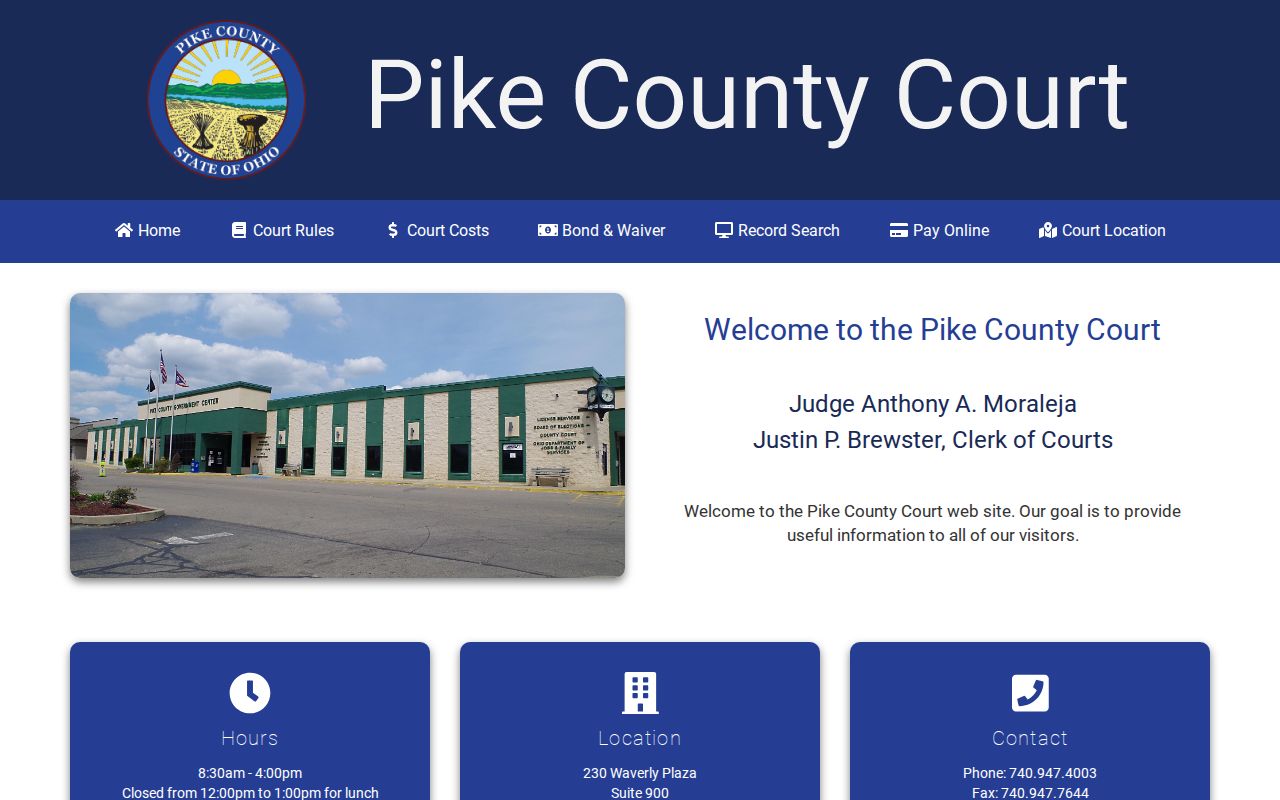
The court navigation connects a record search to the office and procedures behind the docket.
Arkansas Official Background Checks
The Arkansas State Police offers two distinct check paths. The legally mandated or signed-consent system costs $22 per search. The public Arkansas Criminal History portal, known as ARCH, costs $24 per search or result and accepts debit or credit cards online. ARCH may return Arkansas felony and misdemeanor convictions, open Arkansas felony arrests less than three years old, and sex-offender registration status.
ARCH omits juvenile records, sealed convictions, federal matters, and records from other states. It can also miss a conviction when the sentencing court has not sent timely and accurate disposition data to ACIC. The official portal screen makes the separate name-based state channel clear.
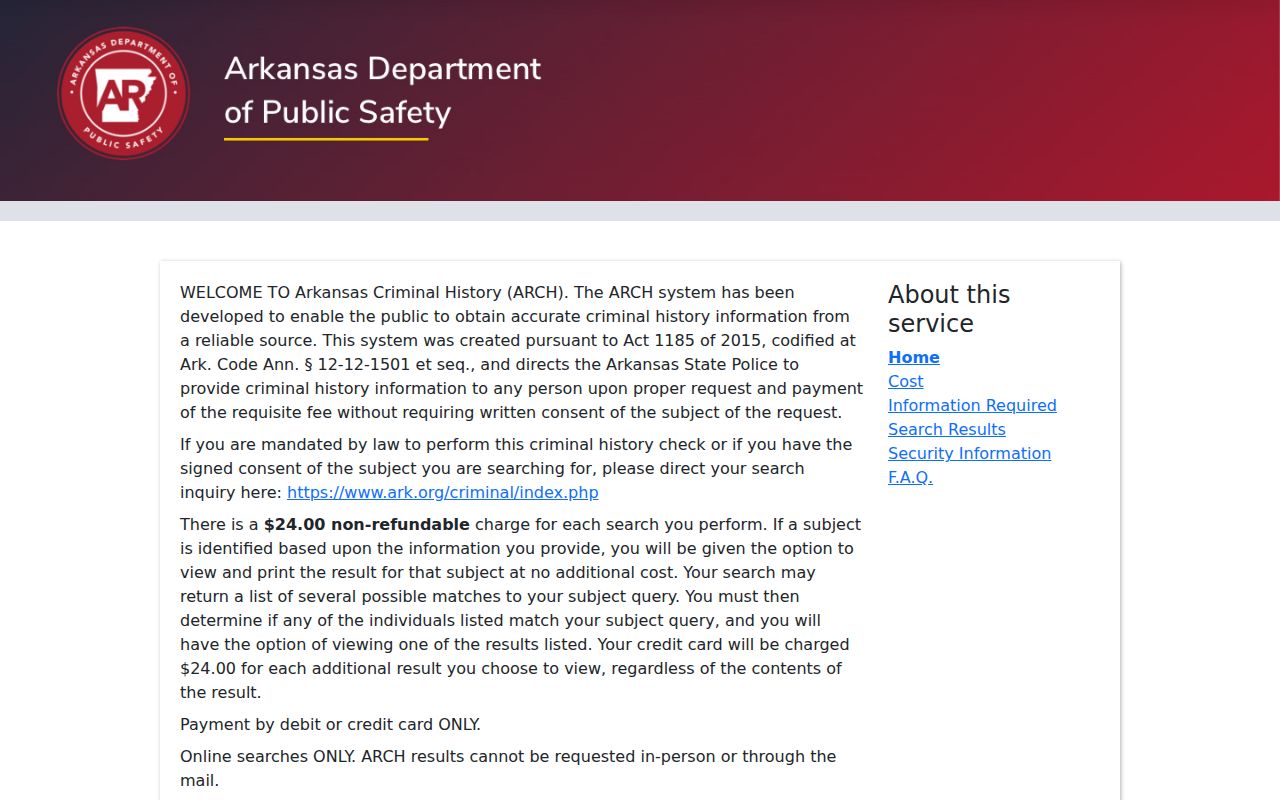
A Pike County ARCH result is broader than one local docket, but narrower than a full fingerprint-based identity record.
| Check | Cost | Best use |
|---|---|---|
| ASP consent or mandated check | $22 | Checks authorized by law or signed consent |
| ARCH open criminal history | $24 | Public name-based Arkansas history |
| Harvester or LiveScan | Varies | Electronic fingerprints sent to ASP AFIS |
Pike County Search ARCourts Choices
Search ARCourts is the statewide court layer for courts that use Contexte. Arkansas Judiciary says a user can search by party name or case number. Results may show parties, judge, filings, charges, dispositions, future events, and judgments. Some public files include document links, while Administrative Order 19 keeps other information from online display.
The Arkansas Judiciary portal information page describes that public access and the move away from older CourtConnect tools.
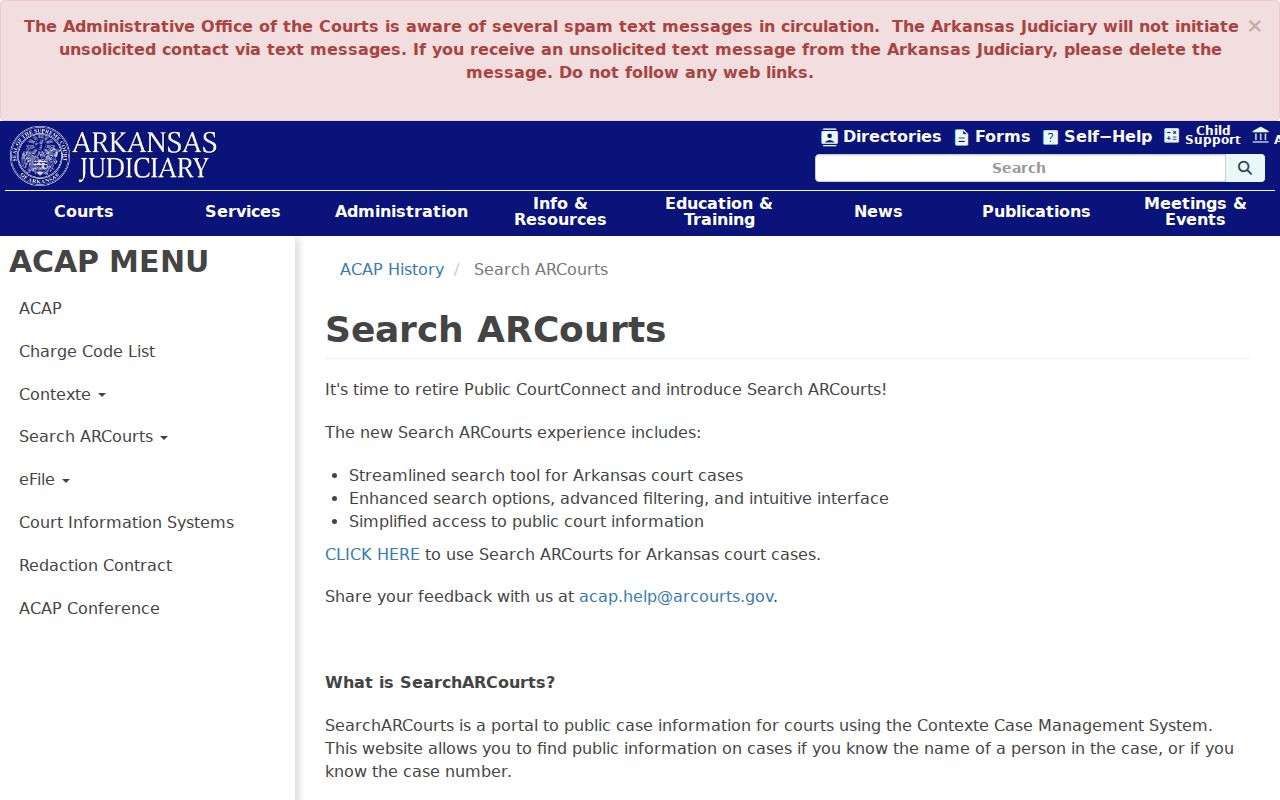
The statewide explanation helps a Pike County user know which case details may be available before opening a search.
The live Search ARCourts interface begins with participant searching and also supports a case-number route.
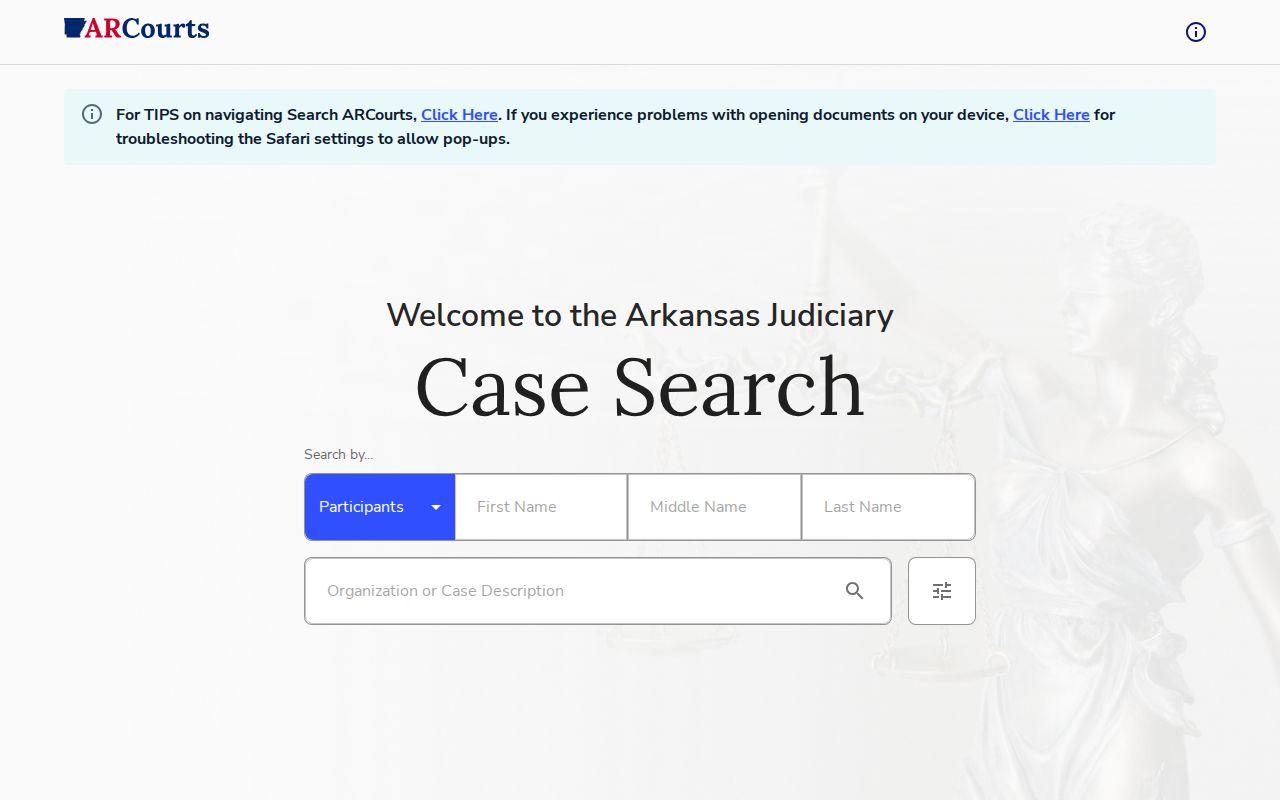
Names can produce several candidates, so county, court, case number, and event details should be compared before treating a result as a match.
| Field | Use | Limit |
|---|---|---|
| Participants | Party-name search | May return similar names |
| Case number | Direct case route | Requires the correct format |
| Documents | View linked public filings | Not all records appear online |
Pike County Criminal Record Types
Each Pike County record answers a different question. An arrest report describes law-enforcement action. A booking file tracks jail intake and custody. A district or municipal case can cover traffic, ordinances, misdemeanors, and early felony steps, while the Arkansas Circuit Court holds felony-level and general-jurisdiction cases. The repository compiles only the categories Arkansas law allows it to release.
- Arrest and booking records: created by the arresting agency and Pike County jail.
- Criminal case files: held by the proper court and clerk after charges are filed.
- Conviction history: reported through courts to Arkansas State Police and ACIC systems.
- Warrants: issued by courts and handled by law enforcement, subject to release limits.
- Supervision and registry files: maintained through Arkansas corrections and ACIC channels.
Pike County Booking Record Route
The Pike County Sheriff's Office is the main local source for jail, booking, arrest, and current custody questions. Its public inmate search can expose field types such as inmate ID, sex, race, age, eye color, and custody detail. Those fields describe a booking record. They do not prove a conviction and may disappear from a current roster after release.
For a broader custody check, the Arkansas Department of Corrections Inmate Search accepts an ADC number, county, first and last name, facility, age, and race. It serves the state prison population, not the Pike County jail roster.
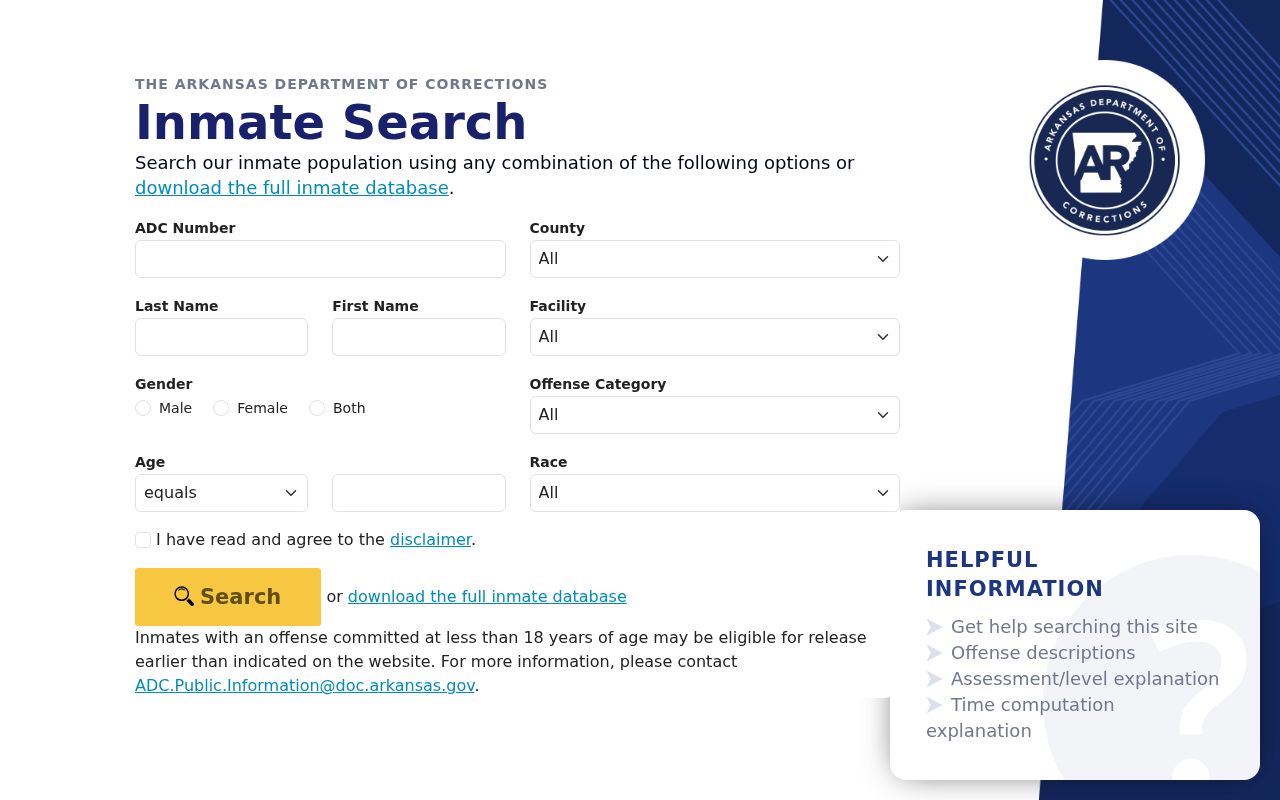
The county filter can help after a Pike County case leads to state custody, but it is not a log of every local arrest.
Arkansas VINE adds custody, court, and supervision notice functions. Its published schedule says county jail data updates about every fifteen minutes, state correction data hourly, and court or supervision information daily. That can make VINE more timely for status alerts than a court disposition page.
Inside a Pike County Criminal Record
A Pike County court file is usually the best source for what happened in one prosecution. Search ARCourts may show charges as filed, future events, dispositions, and judgments. An ARCH result is a narrower state summary. The jail record centers on identity and custody. Comparing all three prevents a booking allegation from being mistaken for the final filed charge.
| Name and identifiers | Legal name, known matching details, case or booking identifiers |
|---|---|
| Arrest and booking | Intake date, listed charge, custody and bond context where released |
| Charges and statutes | Alleged offense and Arkansas code citation filed in court |
| Disposition | Conviction, dismissal, acquittal, plea, or other case result |
| Sentence | Jail or prison term, fine, costs, restitution, or supervision |
| Custody or supervision | Jail, ADC, probation, parole, or post-release status when public |
Note: An arrest charge can change after prosecutor review, so the filed court charge and final disposition deserve separate checks.
Pike County Record Offices
Pike County records geography is compact but split. Court files belong with the court and circuit clerk. Sheriff records and jail entries come from the law-enforcement side. Murfreesboro city reports begin with the city. A written request should name the record type, date range, agency, location, report or case number if known, and the desired format.
Pike County Circuit Clerk
P.O. Box 219
Murfreesboro, AR 71952
(870) 285-2231
Fax: (870) 285-3281
Sabrina.Williams@PikeCountyAR.org
Pike County Sheriff's Office
305 Industrial Park Drive
Murfreesboro, AR 71958
(870) 285-3301
Fax: (870) 285-2626
Monday-Friday, 8:00 a.m.-4:30 p.m.
Murfreesboro City Hall
805 N. Washington Ave.
Murfreesboro, AR 71958
(870) 285-3732
Written city requests may be sent by hand, mail, email, fax, or letter.
Public Access Laws in Arkansas
The Arkansas Freedom of Information Act supports access to public agency records, but it does not erase confidentiality rules. Active-investigation material, juvenile information, medical facts, victim-identifying details, sealed files, and jail-security information may be withheld or redacted. Court online access also follows Administrative Order 19.
Key laws and rules:
Ark. Code § 25-19-101 et seq. establishes the Arkansas Freedom of Information Act.
Ark. Code § 12-12-1503 defines conviction information used in the state dissemination system.
Ark. Code § 12-12-1506 governs unrestricted criminal-history dissemination.
Ark. Code § 16-90-1413 sets the court process for eligible record sealing.
Access is a channel-by-channel issue. A public docket can omit a protected document, while the agency still holds a redacted copy that may be requested under the proper rule.
Pike County Court and ARCH Gaps
A Pike County case may appear in court before ARCH changes. Court staff first record the filing and disposition. That information must then reach ACIC and the Arkansas State Police repository in a timely and accurate form. ARCH itself warns that reporting gaps can leave a conviction out of the name-based result.
For a missing or inaccurate state entry, ACIC provides an authorization route for a person to review criminal history. ACIC does not perform the background check. It directs checks to Arkansas State Police and says that a person or attorney should obtain correct court documentation so the court can send the fix to ACIC. This makes the Pike County clerk the key first stop when the underlying disposition is wrong.
- Disposition
- The court's outcome, such as conviction, dismissal, or acquittal.
- Arraignment
- The hearing where the filed charge is stated and a plea is entered.
- Sealing
- Arkansas's process for restricting an eligible record from ordinary public view.
- Administrative Order 19
- The Arkansas court-record access and confidentiality rule.
Sealed, Expunged, and Restricted Records
Record sealing is the current practical Arkansas term. An eligible person petitions the court that handled the case, and the prosecuting authority has a chance to respond. If the court seals the record, ordinary public searches no longer show it in the same way. ARCH specifically omits sealed convictions. Older sources may use “expungement,” but the active remedy is commonly described as sealing.
Not all Pike County material is eligible or public. Juvenile records, victim and medical details, active-investigation content, and some security facts can remain restricted for reasons unrelated to sealing. A blank search result therefore does not prove that no event occurred. It may mean the wrong system was searched, the record has not yet posted, or the law bars its release.
Pike County Courthouse Record Hub
Murfreesboro became Pike County's seat after the county was established in 1833. The Art Deco courthouse at Courthouse Square was built in 1931-1932 and later placed on the National Register of Historic Places. That long civic role explains why court and clerk research still centers on the square while sheriff and jail work occurs at a separate site.
The Association of Arkansas Counties Pike profile adds an unusual records detail: courthouse deed records include the title history tied to the Crater of Diamonds mine.

That local archive context is separate from criminal history, yet it shows why older verified Pike County records still lead back to the courthouse offices.
Pike County Arrests and Warrants
An arrest is a law-enforcement seizure, not a finding of guilt. A Pike County officer, Murfreesboro or Glenwood police officer, Arkansas State Police trooper, or another authorized officer can create the first report. Jail booking then creates a separate custody entry. Prosecutor review may change the allegation before a formal court charge is filed.
Warrants also require care. A bench warrant may follow a missed court date, while another warrant can arise from a criminal investigation. No comprehensive official online Pike County warrant database was found in the research. The sound route is to check the relevant court and contact the sheriff or issuing agency. A person seeking to resolve their own warrant should use official court or counsel channels rather than relying on a stale web entry. More detail on local booking channels appears in the Pike County arrest lookup.
Pike County Corrections After Court
A sentence may stay local, move into state prison, or place the person under community supervision. The Arkansas Department of Corrections includes the Division of Correction and Division of Community Correction. Probation is state-run through the community correction structure. The Arkansas Post-Prison Transfer Board and corrections system handle post-prison transfer and supervision roles.
VINE can display some custody, court, probation, parole, and post-release status. It is still not the full Pike County case file. The judgment and sentence should be checked with the court, current state imprisonment with ADC, and active county custody with the sheriff. These records can update at different speeds.
A Pike County search should also account for release and transfer. Someone who no longer appears on the sheriff's current inmate list may have posted bond, completed local custody, or entered another facility. Conversely, an ADC entry generally points to state incarceration after the local booking stage. Use the identifiers in each result to follow the same case, then compare the sentencing court and dates. VINE notices are useful for change alerts, but the record-holding office remains the source for a certified fact.
Pike County Criminal Records by City
City police reports begin where the event occurred, but bookings and court filings may move to Pike County or state systems. Glenwood has a cross-county jurisdiction issue because it extends into Pike and Montgomery counties. Murfreesboro is the county seat and has a city court and written public-information route. Delight has no official city records portal documented, so its residents rely more on county channels.
Glenwood Criminal Records
Police records, Pike-side booking, and the cross-county search issue.
Murfreesboro Criminal Records
City police reports, municipal court procedure, and county-seat offices.
Delight Criminal Records
County-first record routes where no city portal was found.